
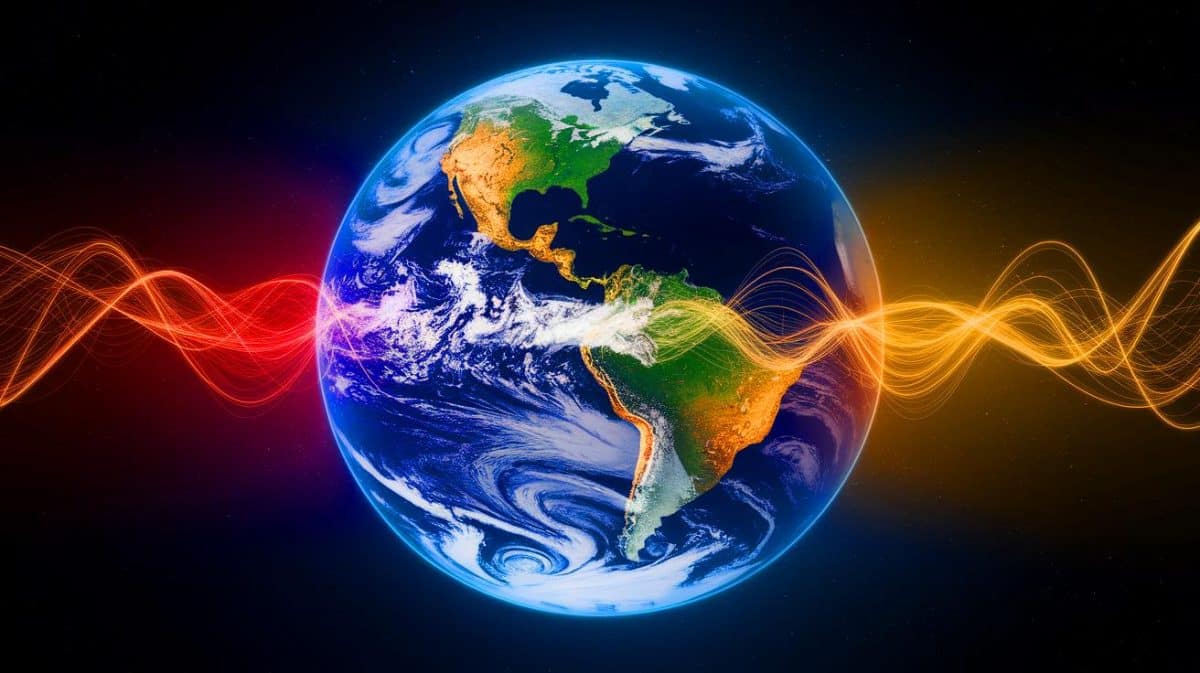
Far below our feet—and high above our heads—something strange is unfolding. A vast and spreading weakness in Earth’s magnetic field, known as the South Atlantic Anomaly (SAA), has captured the attention of NASA scientists and space agencies around the world. Stretching across parts of South America and the South Atlantic Ocean, this zone isn’t just a scientific curiosity—it’s a potential threat to satellites, spacecraft, and our understanding of the planet itself.
He thought he was rescuing a sheep—but it turned out to be something else
This bizarre French customer habit is driving shop owners crazy
What makes it so unsettling? It’s expanding. It’s drifting. And, more recently, it’s begun to split into two.
What’s going on deep inside the Earth?
At the heart of the mystery lies Earth’s magnetic field, a powerful but invisible force generated by the churning motion of molten metals in our planet’s outer core. Think of it as a dynamic shield—protecting us from solar radiation, guiding animal migrations, and making compass needles point north.
But the field isn’t uniform, and in some areas, like the SAA, it’s weakening noticeably. NASA researchers believe two key factors are behind this anomaly. First, Earth’s magnetic axis doesn’t line up perfectly with its rotational axis, creating uneven magnetic strength across the globe. Second, a vast dense region buried deep beneath Africa—called the African Large Low Shear Velocity Province—appears to disrupt the normal flow of energy in the core, causing the magnetic field to falter in this area.
In some parts of the SAA, the magnetic intensity is so reduced that scientists describe it as a “pothole” in Earth’s protective layer. Weijia Kuang, a geophysicist at NASA’s Goddard Space Flight Center, explains that this is due to a local reversal of magnetic polarity, essentially a small patch of magnetic field pointing in the wrong direction.
Why satellites are feeling the heat
This weakened magnetic patch may not be felt on the ground, but its effects in space are hard to ignore. Satellites passing through the SAA are bombarded with high-energy solar particles that the field would normally repel. These can cause what engineers call “single event upsets”—think data glitches, hardware malfunctions, or even full system resets.
Even the International Space Station (ISS) isn’t immune. Instruments onboard occasionally glitch when crossing the anomaly, leading to data losses. Bryan Blair, from NASA’s GEDI mission on the ISS, admits to a few hours of lost data each month due to these electromagnetic hiccups. Other missions, like ICON, have had to design entire operational strategies around avoiding or surviving the anomaly.
A shifting, splitting anomaly
What’s more concerning is that the SAA is on the move. Observations from ESA’s Swarm satellites and NASA’s older SAMPEX mission show the anomaly drifting northwest while simultaneously growing. Since 2020, it’s even begun to divide into two separate lobes, creating a double trouble scenario for spacecraft passing through.
This split makes it trickier for scientists to model and predict the anomaly’s behaviour. Terry Sabaka, also at NASA, stresses the importance of tracking these changes to ensure satellite safety and develop accurate geomagnetic models.
Reading Earth’s signals for the long haul
To keep pace with these changes, researchers are turning to computer models powered by satellite data and simulations of core dynamics. These are used in tools like the International Geomagnetic Reference Field, which helps forecast how Earth’s magnetic field will evolve in the coming decades.
Though the current behaviour of the SAA is unprecedented in the age of space exploration, similar anomalies have likely appeared in Earth’s deep past. One study suggests the planet experienced a similar magnetic dip around 11 million years ago. And despite the drama, scientists are clear: this isn’t an early warning of an imminent magnetic pole reversal—a rare event that occurs over hundreds of thousands of years.
Still, the anomaly serves as a reminder of how little we truly know about the forces shaping our planet from the inside out. As NASA and other space agencies continue to monitor this evolving phenomenon, one thing is certain: the story of the South Atlantic Anomaly is far from over.
Similar Posts
- NASA Sounds the Alarm: Unknown Forces Beneath Earth Spark Global Anomaly
- Earth receives a mysterious laser message from 16 million kilometers away
- NASA confirms China’s giant water project could slow Earth’s rotation and disrupt global timekeeping
- NASA Warns: China Could Slow Down Earth’s Rotation with a Simple Action
- NASA warns: China could slow Earth’s rotation with one bold move

Felix Marlowe manages Belles and Gals’ vibrant social media platforms. With expertise in social engagement and viral marketing, Felix creates content that sparks conversation and keeps followers coming back for more. From celebrity news to trending challenges, Felix makes sure our social media stays at the forefront of pop culture.


