He thought he was rescuing a sheep—but it turned out to be something else
This bizarre French customer habit is driving shop owners crazy
On the night of December 24th, Santa Claus never travels alone. His sleigh, laden with gifts, is pulled by his faithful reindeer. But do you know their names, their number, and the fascinating story surrounding them?
In popular imagination, it’s impossible to separate Santa Claus from his sleigh, drawn by reindeer as legendary as they are intriguing. These faithful companions, with their majestic antlers, are much more than mere animals: they embody the magic of Christmas Eve. Among them, a red-nosed reindeer shines through the fog and leads the pack.
What is the Legend Behind Santa’s Reindeer?
Did you know? The story of Santa’s reindeer originates from an old English poem titled A Visit from St. Nicholas also known as The Night Before Christmas, published in The Sentinel newspaper in 1823. The poem depicts St. Nicholas’s visit on a flying sleigh, pulled by reindeer. This image inspired many other stories and legends about Santa’s reindeer. Here’s an excerpt from the poem that tells the legend of Santa’s reindeer:
“Twas the night before Christmas, when all through the house,
Not a creature was stirring, not even a mouse.
The stockings were hung by the chimney with care,
In hopes that St Nicholas soon would be there.
The children were nestled all snug in their beds,
While visions of sugar-plums danced in their heads.
And mamma in her ‘kerchief, and I in my cap,
Had just settled our brains for a long winter’s nap,
When out on the lawn there arose such a clatter,
I sprang from the bed to see what was the matter.
Away to the window I flew like a flash,
Tore open the shutters and threw up the sash.
The moon on the breast of the new-fallen snow
Gave the lustre of mid-day to objects below.
When, what to my wondering eyes should appear,
But a miniature sleigh, and eight tiny reindeer,
With a little old driver, so lively and quick,
I knew in a moment it must be St Nick.
More rapid than eagles his coursers they came,
And he whistled, and shouted, and called them by name:
‘Now, Dasher! now, Dancer! now, Prancer and Vixen!
On, Comet! on, Cupid! on, Donder and Blitzen!
To the top of the porch! to the top of the wall!
Now dash away! dash away! dash away all!’
(…)
As dry leaves that before the wild hurricane fly,
When they meet with an obstacle, mount to the sky,
So up to the house-top the coursers they flew,
With the sleigh full of Toys, and St Nicholas too.”
What Are the Names of Santa’s Reindeer?
“Now! Dasher, now! Dancer, now! Prancer and Vixen, On! Comet, on! Cupid, on! Donder and Blitzen” Do you recognize them? These are Santa’s nine reindeer. Each reindeer has a unique name and a distinct trait:
- Dasher: the fastest
- Dancer: the most graceful
- Prancer: the most powerful
- Vixen: the strongest
- Comet: brings joy to children
- Cupid: spreads love
- Donder: the most robust
- Blitzen: brings the light
- Rudolph (the red-nosed reindeer): who leads the pack
How Many Reindeer Does Santa Have?
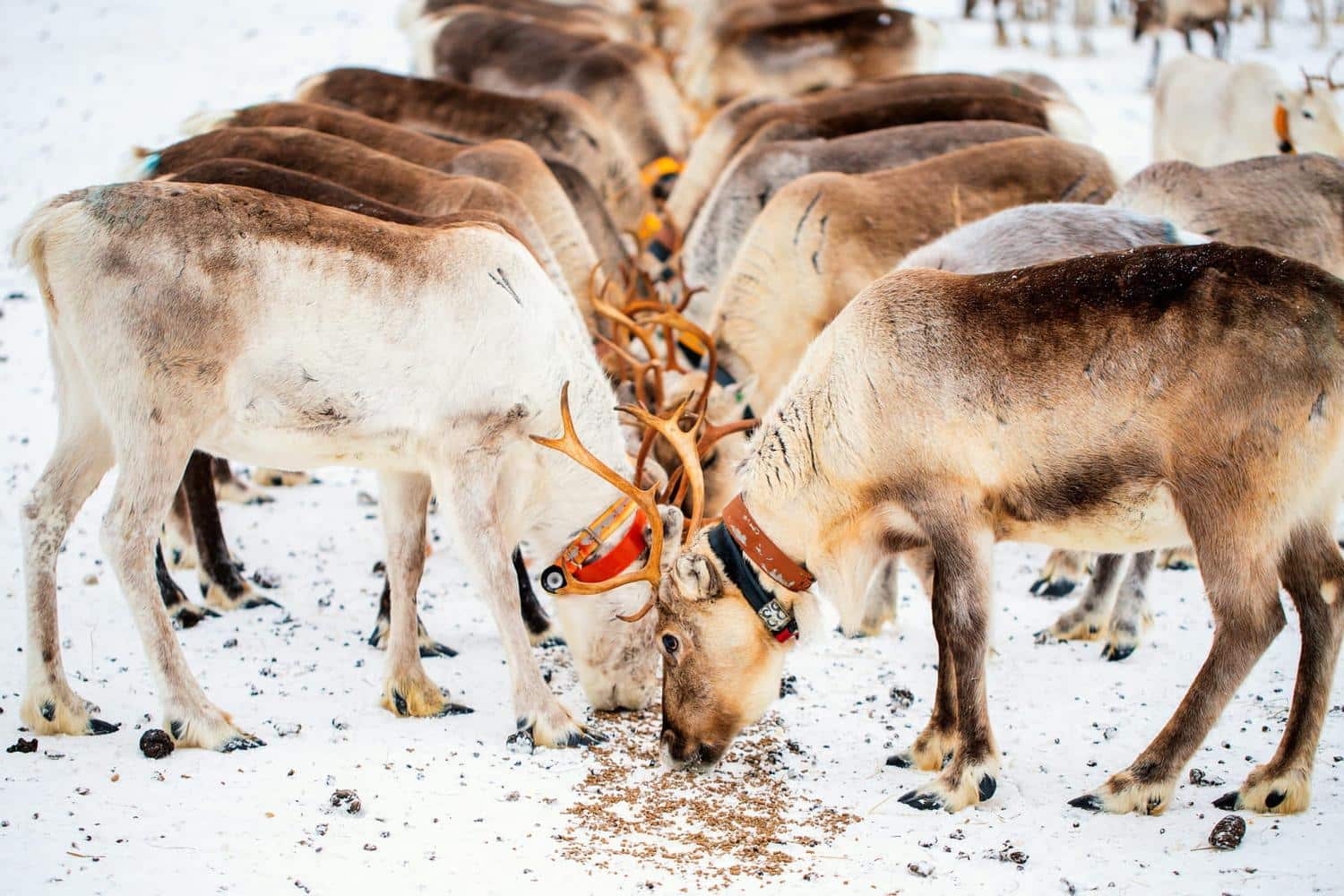
Santa relies on a team of 9 reindeer to accompany him. Originally, he had only 8, but in 1939, writer Robert Lewis May introduced a newcomer (the ninth) in a story: Rudolph. Legend has it that during his tour, Santa spotted a young reindeer with a shining red nose in a clearing in Norway. Charmed by this unique feature, he invited it to join his team to help light up the festive nights, which it accepted.
Moreover, Santa’s reindeer live with him, Mrs. Claus, and the elves in Lapland, far north in Finland. They primarily feed on plants and mushrooms, which is why children sometimes leave hay and carrots for them during Santa’s Christmas tour.
Similar Posts
- Mom Reveals Cute Method to Tell Kids Santa Isn’t Real
- Is Your First Name on Santa’s Nice List? Check Now!
- Who is Saint Nicholas, the Children’s Protector? And His Sidekick, Père Fouettard?
- How Many in France Share Santa Claus’s First Name? Find Out!
- Anne Hathaway, Gigi Hadid, Salma Hayek Stun at 2026 Breakthrough Prize Red Carpet!

Felix Marlowe manages Belles and Gals’ vibrant social media platforms. With expertise in social engagement and viral marketing, Felix creates content that sparks conversation and keeps followers coming back for more. From celebrity news to trending challenges, Felix makes sure our social media stays at the forefront of pop culture.